
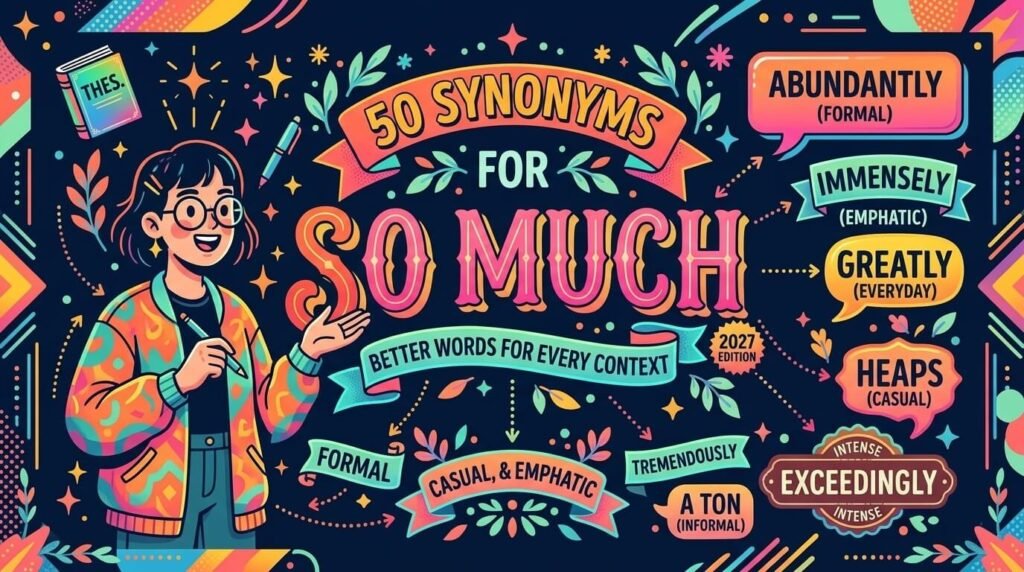

Quick synonyms for so much: a lot, very much, a great deal, greatly, deeply, immensely, tremendously, considerably, significantly, and extremely.
Have you ever used the phrase “so much” again and again in your writing? It is a common English phrase, but using it too often can make your sentences sound repetitive. The good news is that you can express the same idea in many different ways.
For example, you can say “Thank you very much” instead of “Thank you so much.” You can also say “I love you deeply” to express strong feelings. However, the best alternative depends on your sentence. Some words describe a large amount, while others show strong emotions or a high degree.
In this guide, you will discover 50 alternatives to “so much,” with simple meanings, clear examples, and helpful usage tips. These words and phrases can help students, bloggers, content writers, and English learners improve their vocabulary.
What Does So Much Mean?
“So much” is a common English phrase used to express a large amount, a high degree, or a strong feeling.
Its meaning depends on the context.
Examples:
- I have so much work to do today.
- Thank you so much for your kindness.
In the first sentence, “so much” describes a large amount of work. In the second, it adds emphasis to an expression of gratitude.
Part of speech: “So much” is a phrase, not a single word. Depending on the sentence, it can express quantity or degree.
Pronunciation and Syllables
- Pronunciation: /soʊ mʌtʃ/
- Syllables: 2
- Simple pronunciation: soh much
Top 5 Synonyms for So Much
These five alternatives are useful in everyday English, although each one fits different situations.
1. A Lot
Meaning
A large amount or to a great degree.
Examples:
- I have a lot of homework today.
- She cares a lot about her family.
Best use: Everyday conversations and informal writing.
2. Very Much
Meaning
To a great degree, often used to express gratitude, feelings, or preferences.
Examples:
- Thank you very much for your help.
- I enjoy learning English very much.
Best use: Polite expressions, gratitude, and personal feelings.
3. A Great Deal
Meaning
A large amount or a considerable degree.
Examples:
- She has learned a great deal this year.
- Your advice helped me a great deal.
Best use: Describing quantity, learning, help, or change.
4. Greatly
Meaning
To a large degree or extent.
Examples:
- We greatly appreciate your support.
- Her confidence has greatly improved.
Best use: Formal writing and professional communication.
5. Deeply
Meaning
Strongly or with great emotion.
Examples:
- I deeply appreciate your kindness.
- She was deeply moved by his words.
Best use: Expressing love, respect, gratitude, or sadness.
Next 5 Synonyms for So Much
6. Immensely
Meaning
To an extremely great degree.
Examples:
- I enjoyed the trip immensely.
- Your advice helped me immensely.
Best use: Expressing great enjoyment or a strong positive effect.
7. Tremendously
Meaning
To a very great degree.
Examples:
- Her English has improved tremendously.
- We enjoyed the show tremendously.
Best use: Describing major changes or strong positive experiences.
8. Extremely
Meaning
To a very high degree.
Examples:
- I am extremely grateful for your help.
- The children were extremely excited.
Best use: Emphasizing feelings, qualities, or conditions.
9. Considerably
Meaning
By a noticeable or fairly large amount.
Examples:
- The price has increased considerably.
- His writing has improved considerably.
Best use: Describing measurable changes or differences.
10. Significantly
Meaning
By an important or noticeable amount.
Examples:
- The new method significantly improved the results.
- The number of visitors increased significantly.
Best use: Academic writing, reports, and professional communication.
When to Use So Much Synonyms
The best alternative depends on what you want to express. A word that works for gratitude may not work for quantity.
| Situation | Best alternatives | Example |
| Expressing gratitude | Very much, deeply, sincerely | I sincerely appreciate your help. |
| Showing love | Deeply, dearly | I love my family dearly. |
| Describing quantity | A lot, plenty, a great deal | We have a lot of work. |
| Expressing enjoyment | Immensely, greatly | I enjoyed the event immensely. |
| Describing improvement | Considerably, significantly | Her writing improved considerably. |
| Formal writing | Substantially, greatly | Costs increased substantially. |
| Casual conversation | Loads, tons, heaps | We had loads of fun. |
| Describing strong feelings | Profoundly, intensely | His words affected me deeply. |
50 Synonyms and Alternatives for So Much
The following list includes close synonyms, words for specific contexts, and useful expressions. Not every alternative can replace “so much” in every sentence.
1. A Lot
Meaning
A large amount or to a great degree.
Examples:
- I have a lot of work to finish.
- She enjoys spending time with her family a lot.
When to use it: Use “a lot” in everyday English when describing quantity or degree.
2. Very Much
Meaning
To a great degree, especially when expressing feelings or gratitude.
Examples:
- I appreciate your help very much.
- He likes his new school very much.
When to use it: Use it for appreciation, preferences, and feelings.
3. A Great Deal
Meaning
A large amount or a considerable degree.
Examples:
- We learned a great deal during the course.
- The extra practice helped her a great deal.
When to use it: Use it to describe a large amount of learning, help, or change.
4. Greatly
Meaning
To a large degree.
Examples:
- Your advice greatly improved my writing.
- We greatly appreciate your support.
When to use it: Use it in formal writing and professional communication.
5. Deeply
Meaning
Strongly or with powerful emotion.
Examples:
- I deeply respect my parents.
- She was deeply touched by the gift.
When to use it: Use it when describing strong feelings, respect, or gratitude.
6. Immensely
Meaning
To an extremely great degree.
Examples:
- We enjoyed the family gathering immensely.
- Her experience benefited the team immensely.
When to use it: Use it to express great enjoyment or a large benefit.
7. Tremendously
Meaning
To a very great degree.
Examples:
- The business has grown tremendously.
- I appreciate your support tremendously.
When to use it: Use it to emphasize major changes or strong feelings.
8. Extremely
Meaning
To a very high degree.
Examples:
- The weather was extremely hot.
- I am extremely thankful for your support.
When to use it: Use it before adjectives and some adverbs to add emphasis.
9. Considerably
Meaning
By a noticeable or fairly large amount.
Examples:
- The journey took considerably less time.
- Her vocabulary has improved considerably.
When to use it: Use it when describing measurable changes or differences.
10. Significantly
Meaning
By an important or noticeable amount.
Examples:
- The new method significantly improved the results.
- The number of visitors increased significantly.
When to use it: Use it in reports, academic writing, and factual explanations.
11. Hugely
Meaning
To a very great degree.
Examples:
- The event was hugely successful.
- The new product was hugely popular.
When to use it: Use it in informal or conversational writing to emphasize success or popularity.
12. Enormously
Meaning
To an extremely great degree.
Examples:
- The project benefited enormously from her ideas.
- His confidence has grown enormously.
When to use it: Use it when emphasizing a large effect or change.
13. Profoundly
Meaning
In a deep, powerful, or meaningful way.
Examples:
- The story profoundly affected me.
- Her kindness profoundly changed his outlook.
When to use it: Use it for deep emotional or intellectual effects.
14. Intensely
Meaning
With great strength or force.
Examples:
- She felt intensely proud of her daughter.
- He disliked the unfair treatment intensely.
When to use it: Use it to describe strong emotions or experiences.
15. Excessively
Meaning
More than is necessary, reasonable, or desirable.
Examples:
- He worries excessively about small mistakes.
- The room was excessively warm.
When to use it: Use it when something is too much. It usually has a negative meaning.
16. Abundantly
Meaning
In large amounts or more than enough.
Examples:
- Fresh fruit was abundantly available.
- The garden was abundantly supplied with water.
When to use it: Use it for plentiful resources, supplies, or natural things.
17. Ample
Meaning
Enough or more than enough.
Examples:
- We have ample time to finish the task.
- The room provides ample space for everyone.
When to use it: Use it before nouns such as “time,” “space,” and “opportunity.”
18. Plenty
Meaning
A large amount or more than enough.
Examples:
- We have plenty of food for everyone.
- There is plenty of time to prepare.
When to use it: Use it to describe sufficient or large quantities.
19. Loads
Meaning
A large amount; an informal expression.
Examples:
- She has loads of homework.
- We had loads of fun at the party.
When to use it: Use it in friendly conversations, rather than formal reports.
20. Tons
Meaning
A very large amount; an informal expression.
Examples:
- I have tons of work today.
- They took tons of photos on vacation.
When to use it: Use it casually to emphasize a large quantity.
21. Heaps
Meaning
A large amount or many; informal English.
Examples:
- Thanks heaps for your help.
- We have heaps of things to do.
When to use it: Use it in informal conversation, especially in varieties of English where it is common.
22. Numerous
Meaning
Many in number.
Examples:
- She received numerous invitations.
- The guide offers numerous helpful tips.
When to use it: Use it with plural countable nouns, especially in formal writing.
23. Countless
Meaning
Too many to count.
Examples:
- He has helped countless people.
- We made countless happy memories together.
When to use it: Use it to emphasize a very large number.
24. Extensive
Meaning
Large in range, amount, or scope.
Examples:
- The team carried out extensive research.
- She has extensive knowledge of history.
When to use it: Use it before nouns such as “research,” “experience,” and “knowledge.”
25. Substantial
Meaning
Large or important in amount, size, or value.
Examples:
- The company made a substantial profit.
- We made substantial progress this month.
When to use it: Use it in professional writing about significant amounts or progress.
26. Major
Meaning
Important, large, or serious in scale.
Examples:
- The project needs major changes.
- She made a major contribution to the team.
When to use it: Use it for important changes, events, or contributions.
27. Remarkably
Meaning
To an unusual or surprising degree.
Examples:
- He recovered remarkably quickly.
- The children were remarkably calm.
When to use it: Use it when a quality or result is surprising.
28. Exceptionally
Meaning
To a degree that is much higher than usual.
Examples:
- She is exceptionally talented.
- The food was exceptionally good.
When to use it: Use it to highlight an unusually high level of quality or ability.
29. Particularly
Meaning
Especially or more than in other cases.
Examples:
- I particularly enjoyed the final chapter.
- She is particularly interested in science.
When to use it: Use it to emphasize one thing among several.
30. Especially
Meaning
More than usual or more than others in a group.
Examples:
- I especially enjoy spending time with my family.
- This guide is especially useful for beginners.
When to use it: Use it to highlight a specific preference or important point.
31. Highly
Meaning
To a high degree.
Examples:
- She is highly respected by her colleagues.
- This book is highly recommended.
When to use it: Use it with words such as “respected,” “effective,” and “recommended.”
32. Truly
Meaning
Really, sincerely, or genuinely.
Examples:
- I am truly grateful for your help.
- You are truly a wonderful friend.
When to use it: Use it to emphasize sincerity or the truth of a statement.
33. Sincerely
Meaning
Honestly and genuinely.
Examples:
- I sincerely appreciate your kindness.
- She sincerely wished him success.
When to use it: Use it to express genuine gratitude, wishes, or feelings.
34. Heartily
Meaning
With warmth, enthusiasm, or strong feeling.
Examples:
- We heartily welcomed our guests.
- I heartily recommend this book.
When to use it: Use it with verbs such as “welcome,” “recommend,” and “agree.”
35. Wholeheartedly
Meaning
With complete sincerity, support, or commitment.
Examples:
- I wholeheartedly support your decision.
- She wholeheartedly agreed with the proposal.
When to use it: Use it to express complete support or commitment.
36. Passionately
Meaning
With strong emotion or enthusiasm.
Examples:
- He passionately supports the cause.
- She spoke passionately about education.
When to use it: Use it when someone expresses strong feelings about a subject.
37. Fondly
Meaning
With affection or warm feelings.
Examples:
- I fondly remember my school days.
- She spoke fondly of her grandmother.
When to use it: Use it when talking about loving memories or people.
38. Dearly
Meaning
With deep affection; it can also describe a serious cost or consequence.
Examples:
- I love my family dearly.
- He paid dearly for his mistake.
When to use it: Use it with expressions of love or the phrase “pay dearly.”
39. Much
Meaning
To a great degree or a large amount, depending on the sentence.
Examples:
- I appreciate your help very much.
- This version is much better than the old one.
When to use it: Use it with verbs, comparative adjectives, and expressions of degree.
40. By Far
Meaning
By a large margin; used to emphasize a comparison.
Examples:
- This is by far my favorite book.
- She is by far the strongest player on the team.
When to use it: Use it when comparing people, things, or choices.
41. To a Great Extent
Meaning
To a large degree.
Examples:
- The result depends to a great extent on preparation.
- His success was due to a great extent to hard work.
When to use it: Use it in formal explanations about causes, effects, or influence.
42. In Large Measure
Meaning
To a considerable degree or mainly.
Examples:
- Her success was in large measure due to her effort.
- The plan succeeded in large measure because of teamwork.
When to use it: Use it in formal writing when explaining why something happened.
43. Incredibly
Meaning
To an unusually high degree.
Examples:
- I am incredibly grateful for your help.
- The view was incredibly beautiful.
When to use it: Use it to emphasize a strong quality or feeling.
44. Overwhelmingly
Meaning
To a very great degree, often in a powerful or decisive way.
Examples:
- The proposal was overwhelmingly popular.
- The audience responded overwhelmingly positively.
When to use it: Use it for strong support, majority opinions, or powerful effects.
45. Radically
Meaning
In a fundamental or very great way.
Examples:
- The new policy radically changed the system.
- Her approach is radically different from mine.
When to use it: Use it when something changes in a deep or fundamental way.
46. Drastically
Meaning
To a very great degree, often suddenly.
Examples:
- The price dropped drastically.
- We drastically reduced our expenses.
When to use it: Use it for major changes, reductions, or increases.
47. Noticeably
Meaning
In a way that can easily be noticed.
Examples:
- The weather became noticeably colder.
- He looked noticeably happier.
When to use it: Use it when a difference is clear or easy to observe.
48. Markedly
Meaning
Clearly and significantly.
Examples:
- Her writing has improved markedly.
- The new version is markedly better.
When to use it: Use it in formal writing to describe a clear difference or improvement.
49. Appreciably
Meaning
By a noticeable amount or degree.
Examples:
- The changes improved the results appreciably.
- The temperature dropped appreciably overnight.
When to use it: Use it in formal or technical contexts when describing measurable changes.
50. Terribly
Meaning
Very; often used to emphasize feelings or negative experiences.
Examples:
- I am terribly sorry for the delay.
- We missed you terribly.
When to use it: Use it in expressions such as “terribly sorry” or “miss someone terribly.” It does not replace “so much” in every sentence.
Comparison Table: Top 10 Alternatives for So Much
| Alternative | Meaning | Best use |
| A lot | A large amount or degree | Everyday English |
| Very much | To a great degree | Gratitude and feelings |
| A great deal | A large amount or degree | General use |
| Greatly | To a large degree | Formal writing |
| Deeply | With strong emotion | Love and respect |
| Immensely | To an extremely high degree | Enjoyment and benefits |
| Tremendously | To a very great degree | Major changes |
| Extremely | To a very high degree | Emphasis |
| Considerably | By a noticeable amount | Changes and comparisons |
| Significantly | By an important amount | Reports and academic writing |
True Synonyms vs. Related Expressions
Not every alternative has exactly the same meaning as “so much.” Some describe quantity, while others describe emotion, degree, or change.
Close alternatives
- A lot
- Very much
- A great deal
- Much
Words for strong feelings
- Deeply
- Dearly
- Passionately
- Wholeheartedly
Words for degree or change
- Greatly
- Considerably
- Significantly
- Drastically
Words for quantity
- Plenty
- Loads
- Tons
- Heaps
Context-specific alternatives
- Excessively means “more than is reasonable.”
- Terribly can mean “very,” especially in expressions of emotion.
- By far is used for comparisons, not as a general replacement for “so much.”
For example, “I love you so much” can become “I love you dearly.” However, “I have so much work” is more naturally rewritten as “I have a lot of work.”
Antonyms of So Much
“So much” does not have one opposite in every situation. The best antonym depends on whether you are describing quantity or degree.
- A little
- Very little
- Not much
- Slightly
- Hardly
- Barely
- Scarcely
- Minimally
Examples:
- I have very little time today.
- The temperature dropped slightly.
Frequently Asked Questions
1. What is the best synonym for so much?
“A lot” is a useful alternative in everyday English. “Very much” works well for gratitude, while “deeply” can express strong feelings. The best choice depends on your sentence.
2. How can I say “Thank you so much” differently?
You can say:
- Thank you very much.
- I truly appreciate your help.
- I am deeply grateful.
- Many thanks for your support.
3. How can I say “I love you so much” differently?
You can say “I love you deeply,” “I love you dearly,” or “You mean the world to me.” These expressions communicate affection in different ways.
4. What is a formal alternative to so much?
“Considerably,” “substantially,” “greatly,” and “significantly” may work in formal writing, depending on the sentence.
5. Is “so much” the same as “a lot”?
They often express similar meanings, but their grammar differs. “I have a lot of books” describes quantity, while “I like this book so much” expresses a strong feeling.
6. Can I use “immensely” instead of “so much”?
Yes, in sentences such as “I enjoyed the trip so much” and “I enjoyed the trip immensely.” However, it does not fit every use of the phrase.
7. What is the opposite of so much?
Depending on the context, you can use “a little,” “very little,” “not much,” or “slightly.”
8. Is “excessively” a positive synonym for so much?
No. “Excessively” usually means more than is necessary or reasonable, so it often carries a negative meaning.
Conclusion:
“So much” is a common and useful English phrase, but learning alternatives can make your writing clearer and more expressive. Use “a lot” for everyday conversation, “very much” for gratitude, “deeply” for strong feelings, and “significantly” for measurable changes.
Remember that synonyms are not always interchangeable. The right word depends on your meaning and the sentence you are writing. By learning these alternatives and practicing them in context, you can build your vocabulary, avoid repetition, and express your ideas with greater confidence.
READ MORE: Synonyms for Proposed: 50 Useful Alternatives (LATEST 2027)



Pingback: 50 Population Synonyms: Better Words for People and Places