
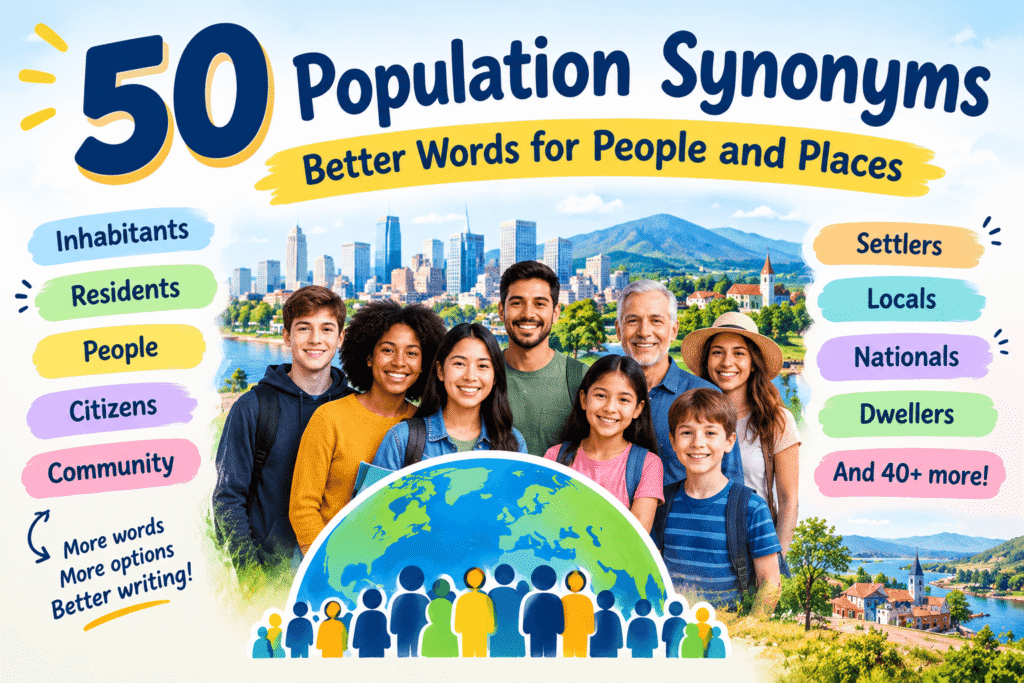

Population synonyms include inhabitants, residents, people, citizens, settlers, and community members. The best word depends on whether you mean people living in an area, the total number of people, or a group that shares a place.
Have you ever written an essay about a city and used the word population again and again? Finding another word can make your writing clearer and more interesting.
Population means the people who live in a place, or the total number of those people. For example, a town may have a population of 10,000 people.
Learning population synonyms helps students write better essays. Bloggers can explain cities and countries in fresh ways. Content writers can avoid repeated words, and English learners can speak with more confidence.
Not every synonym means exactly the same thing. Some words describe people, while others describe a group or the number of people living somewhere. This guide will help you choose the right word for each situation.
Population Synonyms at a Glance
The most useful population synonyms depend on your sentence. Here are five common choices:
- Inhabitants: People who live in a place.
- Residents: People who live in a particular area.
- People: Human beings in general or in a group.
- Citizens: People who belong legally to a country.
- Community: People who live in the same area or share something.
More Population Synonyms to Know
These words can help you describe groups of people, local areas, and changes in the number of people living in a place.
- Dwellers: People who live in a particular place.
- Settlers: People who move to a new area to live.
- Locals: People who live in a particular area.
- Nationals: People who belong to a particular nation.
- Occupants: People who live in or use a building or place.
Pronunciation of “Population”
- Phonetic spelling: pop-yuh-LAY-shun
- IPA: /ˌpɒp.jəˈleɪ.ʃən/ (British English)
- Simple breakdown: Pop + yuh + LAY + shun
Say the word slowly first, then join the sounds together. The strongest sound is LAY.
Syllables of “Population”
The word population has four syllables:
pop – u – la – tion
Each part is a small sound group. Say the word as pop-yuh-LAY-shun to make it easier to pronounce.
When to Use Population Synonyms
Choose a word based on what you want to say.
- Use population when talking about the total number of people living in an area.
- Use inhabitants when describing the people who live in a place.
- Use residents when discussing people who live in a town, city, or building.
- Use citizens when citizenship or legal rights matter.
- Use community when talking about people connected by a place or shared interest.
- Use demographic when discussing facts about a group, such as age or income. It is not a direct synonym for population.
- Use headcount when referring to the number of people counted.
- Use crowd when describing many people gathered together in one place.
Remember: a synonym should fit the meaning of your sentence. A word that describes people is not always a good replacement for the total number of people.
Population Synonyms Comparison Table
Here are ten useful words, their meanings, and the best ways to use them.
| Word | Meaning | Best use |
| Inhabitants | People living in a place | Geography and reports |
| Residents | People who live in an area | Local news and daily writing |
| People | Human beings | General conversation |
| Citizens | Legal members of a country | Government and civic topics |
| Community | People connected by place or interest | Social topics |
| Dwellers | People living in a place | Descriptive writing |
| Locals | People from a nearby area | Travel and everyday speech |
| Settlers | People who establish homes in a new area | History |
| Nationals | People belonging to a nation | Law and international affairs |
| Headcount | The number of people counted | Workplaces and surveys |
List of 50 Population Synonyms
The following 50 words and phrases can help you describe people, groups, and the number of people living in a place. Some are direct alternatives, while others are related terms that work only in certain contexts.
1. Inhabitants
Meaning
Inhabitants are people who live in a place.
Examples
- The inhabitants of this village grow their own food.
- The city has thousands of new inhabitants.
2. Residents
Meaning
Residents are people who live in a particular area.
Examples
- Local residents want a new park.
- The residents of our street know each other well.
3. People
Meaning
People are human beings who live, work, or spend time somewhere.
Examples
- Many people live near the river.
- The town’s people came together to help.
4. Citizens
Meaning
Citizens are people who legally belong to a country.
Examples
- Citizens voted in the national election.
- The city provides services for its citizens.
5. Community
Meaning
A community is a group of people who live in the same area or share an interest.
Examples
- Our community raised money for the school.
- The small community welcomed the new families.
6. Dwellers
Meaning
Dwellers are people who live in a particular place.
Examples
- City dwellers often use public transport.
- The island’s dwellers depend on fishing.
7. Locals
Meaning
Locals are people who live in the area being discussed.
Examples
- The locals showed us the best places to eat.
- Many locals work at the nearby factory.
8. Settlers
Meaning
Settlers are people who move to a place to make it their home.
Examples
- Early settlers built homes near the river.
- The settlers worked hard to grow their food.
9. Nationals
Meaning
Nationals are people who belong to a particular country.
Examples
- Foreign nationals must follow local laws.
- The report included nationals living overseas.
10. Occupants
Meaning
Occupants are people who live in or use a place.
Examples
- The building’s occupants left safely.
- All occupants must follow the safety rules.
11. Populace
Meaning
The populace is the group of people living in a country or area.
Examples
- The new law affected the entire populace.
- The ruler listened to the needs of the populace.
12. Citizenry
Meaning
The citizenry is the body of citizens in a country or community.
Examples
- The citizenry took part in the public debate.
- The plan received support from the local citizenry.
13. Public
Meaning
The public is the group of people in a society or community.
Examples
- The public asked for cleaner streets.
- The report was shared with the general public.
14. Society
Meaning
Society is a group of people who live together under shared rules and systems.
Examples
- Education helps society grow.
- Every society needs safe places for children.
15. Human population
Meaning
The human population is the total number of people in a place or across the world.
Examples
- The world’s human population continues to change.
- The island has a small human population.
16. Local population
Meaning
The local population is the group of people living in a specific area.
Examples
- The local population needs better roads.
- The local population grew after the new factory opened.
17. Urban population
Meaning
The urban population is the group of people living in towns and cities.
Examples
- The urban population grew over ten years.
- Better jobs attracted people to the urban population centers.
18. Rural population
Meaning
The rural population is the group of people living in the countryside.
Examples
- The rural population depends on farming.
- New clinics can help the rural population.
19. City population
Meaning
The city population is the total number of people living in a city.
Examples
- The city population reached one million.
- The city population grew as new homes were built.
20. Town population
Meaning
The town population is the total number of people living in a town.
Examples
- The town population doubled in twenty years.
- The town population is smaller than that of the nearby city.
21. Village population
Meaning
The village population is the total number of people living in a village.
Examples
- The village population is about 800.
- The village population fell as families moved away.
22. Community members
Meaning
Community members are people who belong to or take part in a community.
Examples
- Community members cleaned the local park.
- The meeting was open to all community members.
23. Local residents
Meaning
Local residents are people who live in the area nearby.
Examples
- Local residents complained about the noise.
- The new library is popular with local residents.
24. City residents
Meaning
City residents are people who live within a city.
Examples
- City residents asked for more bus routes.
- Many city residents live in apartments.
25. Town residents
Meaning
Town residents are people who live in a town.
Examples
- Town residents gathered for the festival.
- Town residents enjoy the weekly market.
26. Rural inhabitants
Meaning
Rural inhabitants are people who live in the countryside.
Examples
- Rural inhabitants may travel far to reach a hospital.
- The road connects rural inhabitants with nearby towns.
27. Urban dwellers
Meaning
Urban dwellers are people who live in cities or towns.
Examples
- Urban dwellers often live close to shops.
- Many urban dwellers use trains to get to work.
28. City dwellers
Meaning
City dwellers are people who make their homes in cities.
Examples
- City dwellers enjoy many public services.
- Some city dwellers move to quieter areas.
29. Country dwellers
Meaning
Country dwellers are people who live in the countryside.
Examples
- Country dwellers may have large gardens.
- Country dwellers often travel by car.
30. Village inhabitants
Meaning
Village inhabitants are people who live in a village.
Examples
- Village inhabitants helped repair the bridge.
- The village inhabitants welcomed the visiting team.
31. Residents of an area
Meaning
Residents of an area are people who make their homes in that place.
Examples
- Residents of the area asked for streetlights.
- The project will help residents of the area.
32. People living in an area
Meaning
This phrase describes all the people who live in a particular place.
Examples
- People living in the area received a warning.
- The survey asked people living in the area about transport.
33. Number of people
Meaning
The number of people is the total count of people in a group or place.
Examples
- The number of people in the hall reached 200.
- We counted the number of people at the event.
34. Total inhabitants
Meaning
Total inhabitants means all the people living in a place.
Examples
- The report listed the total inhabitants of each island.
- The total inhabitants of the region increased.
35. Population count
Meaning
A population count is the recorded number of people in an area.
Examples
- The latest population count showed steady growth.
- Officials checked the population count before planning a school.
36. Headcount
Meaning
A headcount is a count of the people in a group.
Examples
- The teacher took a headcount before the trip.
- The company checked its headcount at the end of the year.
37. Census population
Meaning
Census population is the number of people recorded in a census.
Examples
- The census population rose between the two surveys.
- Researchers compared the census population of both towns.
38. Population size
Meaning
Population size is the total number of people living in a place or group.
Examples
- The population size affects the need for schools.
- Scientists studied the population size of the island.
39. Population total
Meaning
Population total means the full number of people in a place or group.
Examples
- The table shows the population total for each state.
- The population total changed after the census.
40. Human community
Meaning
A human community is a group of people connected by a place or shared life.
Examples
- The human community worked together after the storm.
- Every human community needs clean water.
41. Inhabiting group
Meaning
An inhabiting group is a group of people or living things that live in a place.
Examples
- Researchers studied the inhabiting group of the remote island.
- The report described the inhabiting group in the valley.
42. Resident population
Meaning
The resident population includes people who normally live in an area.
Examples
- The resident population grew over the past decade.
- The resident population needs more health services.
43. Permanent residents
Meaning
Permanent residents are people who live in a place on a lasting basis.
Examples
- Permanent residents can apply for certain local services.
- The island has few permanent residents during winter.
44. Permanent inhabitants
Meaning
Permanent inhabitants are people who make a place their lasting home.
Examples
- The island has only a few permanent inhabitants.
- Permanent inhabitants helped protect the old village.
45. Registered residents
Meaning
Registered residents are people officially listed as living in a place.
Examples
- Registered residents received the notice.
- The office updated its list of registered residents.
46. Voter population
Meaning
The voter population is the group of people eligible to vote in an area.
Examples
- The voter population grew before the election.
- The campaign focused on the needs of the voter population.
47. Working population
Meaning
The working population is the group of people who work or are available for work, depending on the definition used.
Examples
- The working population needs access to training.
- New jobs helped the working population in the region.
48. Age group
Meaning
An age group is a set of people within a certain range of ages.
Examples
- The survey studied the youngest age group.
- Each age group had different needs.
49. Demographic group
Meaning
A demographic group is a set of people who share a trait, such as age or location.
Examples
- The study focused on a younger demographic group.
- The service was designed for a specific demographic group.
50. Human residents
Meaning
Human residents are people who live in a particular place.
Examples
- The human residents of the island rely on boats.
- The report counted human residents in each settlement.
How Population Synonyms Improve Your Writing
Learning words related to population helps you explain facts in a clear way. It also helps you avoid repeating the same word in every sentence.
For example:
- Instead of “The population of the city is growing,” write “The number of city residents is growing.”
- Instead of “The population needs help,” write “The local community needs help.”
- Instead of “The population was counted,” write “Officials counted the residents.”
These population alternatives can make essays, reports, blog posts, and school projects easier to read.
However, always check the meaning before replacing a word. Residents describe people who live somewhere, while population size describes how many people live there. Citizens has a legal meaning, so it is not suitable for every situation.
Frequently Asked Questions About Population Synonyms
What is another word for population?
Inhabitants, residents, populace, and people are common alternatives. The best choice depends on the sentence. Use population size when you mean the total number of people.
What are the five synonyms of population?
Five useful choices are inhabitants, residents, populace, people, and community. Remember that community often means a connected group rather than a total count.
What is a synonym for a large population?
You can use phrases such as a large number of people, many inhabitants, or a densely populated area. These phrases describe different things, so choose the one that fits your meaning.
What is the opposite of population?
There is no single exact opposite of population. Depending on the context, you might use depopulation to describe a decline in the number of people or an uninhabited area to describe a place where no one lives.
What is the difference between population and inhabitants?
Population often means the total number of people living in an area. Inhabitants means the people who live there.
For example, “The town has a population of 5,000” gives a number. “The inhabitants are friendly” describes the people.
What is the difference between population and community?
Population often refers to all the people living in an area. Community usually refers to people connected by a place, shared interests, or common goals.
A city can have one large population and many different communities.
How can I use population synonyms in an essay?
Use words such as residents, inhabitants, and local people when they fit your meaning. Use population size or number of people when discussing figures.
Avoid replacing every use of population with a different word. Clear meaning is more important than variety.
What does population mean in geography?
In geography, population usually means the people living in a specific area, such as a village, city, country, or region. Geographers study population size, density, distribution, and change.
What is the difference between population and demographic?
Population refers to the people in an area or group. Demographic relates to features of those people, such as age, income, or education.
For example, a city’s population may be one million, while its age demographics show how many residents are young or old.
Why should students learn population synonyms?
These words help students write better essays, understand geography lessons, and explain facts without repeating the same terms. They also build vocabulary and improve everyday English.
Conclusion:
Learning population synonyms can make your English stronger and your writing more interesting. Words like inhabitants, residents, populace, and community help you describe people and places in different ways.
Using synonyms for population can improve your essays, blog posts, reports, and daily conversations. These population alternatives also help you explain facts without repeating the same words. When you need another word for population, think about whether you mean people, a group, or a total number.
Build your population vocabulary by practicing these terms in emails, essays, social media captions, and everyday talks. Learn the meaning of each word before using it. Remember that population terminology includes both direct alternatives and related terms, so context matters.
Keep reading, writing, and practicing. Every new word you learn helps you express your ideas with greater confidence. Keep learning, keep growing, and let your words make a difference!
READ MORE: 50 Synonyms for So Much: Better Words for Every Context (2027).



Pingback: 50 Odd Synonyms: Better Words for Strange and Unusual Things
Pingback: 50 Mediocre Synonyms: Better Words to Use In 2027
Pingback: 50 Exploring Synonyms for Better Writing In 2027