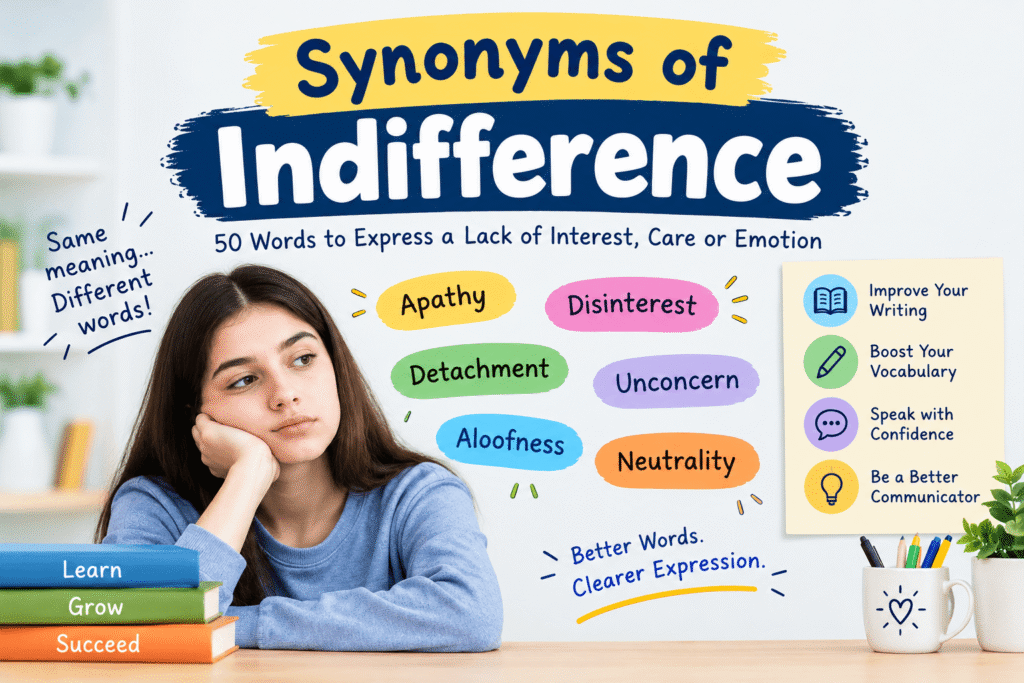

Apathy • Detachment • Disinterest • Unconcern • Impassivity • Neutrality
Have you ever shared exciting news with someone, only to see them respond without any interest? Perhaps they barely reacted or seemed unconcerned about what you said. This feeling or attitude can be described as indifference.
The word indifference means a lack of interest, care, or strong feelings about something. For example, if a student shows indifference toward a school project, they may not care much about its result.
Learning synonyms of indifference can help you describe feelings, behavior, and reactions more clearly. Students can use these words in essays, while bloggers and content writers can use them to explain characters and real-life situations. They are also useful in everyday conversations.
Each synonym has a slightly different meaning. Some describe a lack of interest, while others suggest calmness, emotional distance, or a lack of concern.
Top 5 Synonyms of Indifference
- Apathy
- Disinterest
- Detachment
- Unconcern
- Impassivity
Next 5 Synonyms of Indifference
- Neutrality
- Aloofness
- Uninvolvement
- Nonchalance
- Insensitivity
Pronunciation of “Indifference”
- Phonetic spelling: in-DIF-er-uhns
- IPA: /ɪnˈdɪf.ər.əns/
- Simple breakdown: in + DIF + er + ence
- Part of speech: Noun
The main stress falls on DIF. Say each part slowly, then join the sounds together to pronounce the full word.
Syllables of Indifference
The word indifference has four syllables:
in-dif-fer-ence
Try saying it slowly: in-DIF-er-ence. The second syllable receives the strongest stress.
When to Use Synonyms of Indifference
Choose a synonym based on the type of attitude or behavior you want to describe.
- Apathy: A lack of interest or motivation.
- Disinterest: A lack of interest in a topic or activity.
- Detachment: Emotional distance from a person or situation.
- Unconcern: A lack of worry or care.
- Impassivity: A lack of visible emotion.
- Neutrality: Not taking either side in a disagreement.
- Aloofness: Appearing distant or unfriendly.
- Uninvolvement: Not taking part in something.
- Nonchalance: Acting calm and unconcerned.
- Insensitivity: Not noticing or caring about another person’s feelings.
For example, a person may show apathy toward a task, remain neutral during an argument, or respond with nonchalance to unexpected news.
These words are related, but they are not always interchangeable. Choose the one that best fits the situation.
Comparison Table: Top 10 Synonyms of Indifference
| Synonym | Simple meaning | Common usage |
|---|---|---|
| Apathy | Lack of interest or motivation | Work, social issues |
| Disinterest | Lack of interest | Hobbies, discussions |
| Detachment | Emotional distance | Relationships, decisions |
| Unconcern | Lack of worry | Problems, risks |
| Impassivity | Showing little emotion | Facial expressions, reactions |
| Neutrality | Not favoring either side | Debates, conflicts |
| Aloofness | Keeping an emotional distance | Social behavior |
| Uninvolvement | Not participating | Groups, activities |
| Nonchalance | Acting casually or unconcernedly | Reactions, conversations |
| Insensitivity | Lack of awareness of feelings | Relationships, communication |
List of 50 Synonyms of Indifference
The following words and expressions describe different forms of indifference, including a lack of interest, concern, emotion, or involvement. Some are direct synonyms, while others describe related attitudes.
1. Apathy
Meaning
A lack of interest, care, or motivation.
Examples
- His apathy toward school worried his parents.
- Public apathy made the meeting less active.
2. Disinterest
Meaning
A lack of interest in something.
Examples
- She showed disinterest in the long lecture.
- His disinterest in sports surprised his friends.
3. Detachment
Meaning
A state of being emotionally distant from something.
Examples
- She discussed the problem with emotional detachment.
- His detachment made it hard to understand his feelings.
4. Unconcern
Meaning
A lack of worry or care about something.
Examples
- His unconcern about the deadline upset the team.
- She showed unconcern about the small delay.
5. Impassivity
Meaning
The quality of showing little or no emotion.
Examples
- His impassivity made his reaction hard to read.
- She listened with impassivity during the debate.
6. Neutrality
Meaning
The state of not supporting either side.
Examples
- The judge maintained neutrality during the dispute.
- Her neutrality helped both friends feel heard.
7. Aloofness
Meaning
The quality of seeming distant or not friendly.
Examples
- His aloofness made it hard to start a conversation.
- She mistook his quietness for aloofness.
8. Uninvolvement
Meaning
The state of not taking part in something.
Examples
- His uninvolvement in the project slowed the work.
- The group noticed her uninvolvement in the discussion.
9. Nonchalance
Meaning
A calm manner that shows little worry or excitement.
Examples
- He accepted the news with nonchalance.
- Her nonchalance surprised everyone in the room.
10. Insensitivity
Meaning
A lack of care or understanding for other people’s feelings.
Examples
- His insensitivity hurt his friend’s feelings.
- She regretted her insensitivity during the conversation.
11. Indifference of attitude
Meaning
A way of acting that shows little interest or concern.
Examples
- His indifference of attitude upset the group.
- She noticed an indifference of attitude toward the task.
12. Unresponsiveness
Meaning
A failure to react or respond.
Examples
- His unresponsiveness made the meeting difficult.
- The teacher noticed her unresponsiveness to questions.
13. Passivity
Meaning
The state of not taking action or showing initiative.
Examples
- His passivity kept him from sharing ideas.
- The coach challenged the team’s passivity.
14. A lack of concern
Meaning
A state of not caring much about something.
Examples
- Her lack of concern about the rules caused problems.
- He showed a lack of concern for the deadline.
15. A lack of interest
Meaning
Not feeling curious or eager about something.
Examples
- A lack of interest made the lesson feel long.
- His lack of interest in reading soon became clear.
16. Emotional distance
Meaning
A state of not feeling close to another person.
Examples
- Emotional distance grew between the two friends.
- She noticed emotional distance in their conversations.
17. Coldness
Meaning
A manner that seems unfriendly or lacking in warmth.
Examples
- His coldness surprised his new coworkers.
- She felt the coldness in his reply.
18. Unfeelingness
Meaning
A lack of sympathy or emotion toward others.
Examples
- His unfeelingness upset the people around him.
- She disliked the unfeelingness of the remark.
19. Insouciance
Meaning
A relaxed attitude that shows little worry.
Examples
- He faced the change with insouciance.
- Her insouciance seemed odd during the serious talk.
20. Apathy toward
Meaning
A lack of interest or care about a particular subject.
Examples
- His apathy toward politics was well known.
- Apathy toward safety rules can cause harm.
21. Indifference to
Meaning
A lack of concern or interest in something.
Examples
- Her indifference to praise surprised the class.
- His indifference to the result confused his coach.
22. Dispassion
Meaning
A state of being free from strong emotion.
Examples
- She reviewed the complaint with dispassion.
- His dispassion helped him compare the options fairly.
23. Impartiality
Meaning
The quality of treating people or sides fairly.
Examples
- The referee showed impartiality throughout the match.
- Impartiality is important when judging a contest.
24. Neutralism
Meaning
The position of remaining neutral rather than taking sides.
Examples
- The debate raised questions about neutralism.
- His neutralism kept him outside the argument.
25. Withdrawal
Meaning
The act of moving away from an activity or situation.
Examples
- Her withdrawal from the club surprised her friends.
- His withdrawal from the discussion left questions unanswered.
26. Disengagement
Meaning
The state of being disconnected or no longer involved.
Examples
- Student disengagement affected class discussions.
- His disengagement from the project became clear.
27. Nonparticipation
Meaning
The act of not joining or taking part.
Examples
- Her nonparticipation affected the group activity.
- Nonparticipation was allowed during the optional game.
28. Indolence
Meaning
A habit of avoiding effort or activity.
Examples
- His indolence kept him from finishing his work.
- She tried to overcome her indolence by setting small goals.
29. Lethargy
Meaning
A lack of energy or enthusiasm.
Examples
- The team’s lethargy showed during practice.
- He struggled with lethargy on the hot afternoon.
30. Listlessness
Meaning
A state of having little energy or interest.
Examples
- Her listlessness made the class feel unusually quiet.
- He felt listlessness after a long day.
31. A lack of enthusiasm
Meaning
Not showing much excitement or eagerness.
Examples
- His lack of enthusiasm was clear during the meeting.
- The students showed a lack of enthusiasm for the activity.
32. A lack of motivation
Meaning
Not feeling driven to do something.
Examples
- A lack of motivation made studying harder.
- She overcame her lack of motivation by making a plan.
33. Unmoved
Meaning
Not emotionally affected by something.
Examples
- He remained unmoved by the sad story.
- She seemed unmoved by the criticism.
34. Unimpressed
Meaning
Not feeling admiration or excitement.
Examples
- The audience was unimpressed by the speech.
- She looked unimpressed with the new design.
35. Uninterested
Meaning
Not wanting to know more about something.
Examples
- He seemed uninterested in the topic.
- The child was uninterested in the television show.
36. Uncaring
Meaning
Not showing care or concern for others.
Examples
- His uncaring response hurt her.
- An uncaring attitude can damage friendships.
37. Unfeeling
Meaning
Not showing sympathy or concern.
Examples
- The unfeeling comment upset the team.
- She thought his reply sounded unfeeling.
38. Apathetic
Meaning
Showing little interest or concern.
Examples
- The apathetic audience barely reacted.
- He became apathetic toward his daily tasks.
39. Detached
Meaning
Not emotionally involved in a situation.
Examples
- She stayed detached while reviewing the facts.
- His detached tone made the message seem cold.
40. Indifferent
Meaning
Not caring much or having no strong preference.
Examples
- I am indifferent to which movie we watch.
- He seemed indifferent to the final score.
41. Aloof
Meaning
Distant or not very friendly.
Examples
- The new student seemed aloof at first.
- She sounded aloof during the phone call.
42. Impassive
Meaning
Showing little or no emotion.
Examples
- His impassive face revealed nothing.
- She remained impassive as the results were announced.
43. Nonchalant
Meaning
Calm and casual, without showing much worry.
Examples
- He gave a nonchalant shrug.
- She sounded nonchalant about the delay.
44. Unresponsive
Meaning
Not reacting or answering.
Examples
- He was unresponsive to repeated questions.
- The audience remained unresponsive to the joke.
45. Passive
Meaning
Not taking action or showing much initiative.
Examples
- He took a passive role in the project.
- Her passive response did not solve the problem.
46. Apathetically
Meaning
In a way that shows little interest or care.
Examples
- He apathetically scrolled through the messages.
- She apathetically agreed to the plan.
47. Indifferently
Meaning
In a way that shows little interest or concern.
Examples
- He answered indifferently and returned to work.
- She looked indifferently at the empty box.
48. Dispassionately
Meaning
In a calm way without strong emotion.
Examples
- The manager dispassionately reviewed the evidence.
- She dispassionately compared both proposals.
49. Unconcerned
Meaning
Not worried about something.
Examples
- He seemed unconcerned about the small mistake.
- She remained unconcerned while waiting for the reply.
50. Emotionally distant
Meaning
Not showing much emotional closeness or warmth.
Examples
- He seemed emotionally distant after the argument.
- She felt that her friend had become emotionally distant.
Vocabulary tip: The closest synonyms of indifference are usually apathy, disinterest, detachment, and unconcern. Words such as neutrality and impartiality can have positive meanings because they may describe fairness rather than a lack of care.
Frequently Asked Questions
What is the best synonym for indifference?
Apathy is one of the closest synonyms for indifference. It describes a lack of interest, care, or motivation. Detachment is more suitable when you mean emotional distance.
What is another word for indifference in a sentence?
You can use disinterest, apathy, unconcern, or detachment. For example: “His apathy toward the project surprised his coworkers.”
What is the difference between indifference and apathy?
Indifference means not having a strong interest, preference, or concern. Apathy often suggests a deeper lack of interest or motivation, sometimes across many areas of life.
What is the opposite of indifference?
Possible opposites include interest, concern, compassion, enthusiasm, and involvement. The best choice depends on whether you mean emotional care, curiosity, or active participation.
Is indifference a positive or negative word?
It depends on the context. Indifference can suggest unfairness or a lack of compassion when someone ignores another person’s needs. However, remaining emotionally detached can sometimes help a person make a fair decision.
How can I use synonyms of indifference in an essay?
Choose a word that matches the situation. Use apathy to describe a lack of motivation, aloofness for social distance, and nonchalance for a casual reaction. These choices make your writing more precise.
Conclusion
Learning the synonyms of indifference can help you describe emotions, attitudes, and behavior with greater clarity. Words like apathy, disinterest, detachment, and unconcern are useful when you want to explain a lack of interest or care. Other alternatives, such as impassivity and nonchalance, describe how someone reacts to a situation.
Use these indifference synonyms in essays, blog posts, emails, book reviews, and daily conversations. When choosing another word for indifference, consider the feeling you want to express. A person may be uninterested in a topic, detached from a situation, or unconcerned about a result. Each phrase gives readers a different picture.
Building your vocabulary takes practice, so try learning a few words each day. Write your own sentences and notice how these words appear in books and conversations.
Every new word helps you express your thoughts more clearly and understand others a little better.
Synonyms of Perseverance: Powerful Words for Never Giving Up.