

Stakeholder synonyms include interested parties, participants, partners, decision-makers, shareholders, contributors, and people affected by a project or decision.
When people work on a project, many people may care about its success. Some give money. Others share ideas, make choices, or use the final result. What can we call all these people? This is where synonyms for stakeholders become useful.
A stakeholder is a person or group that has an interest in something or may be affected by it. For example, in a school project, teachers, students, parents, and school leaders can all be stakeholders.
Learning another word for stakeholders helps you write better emails, reports, essays, and business documents. It also helps students, bloggers, content writers, and daily English users explain ideas in clear and simple words.
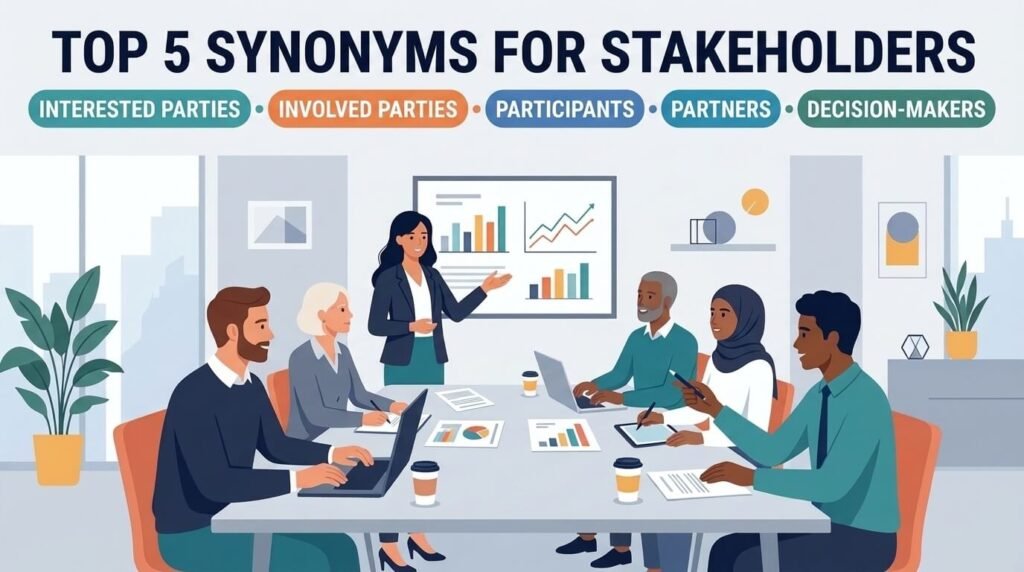
Top 5 Synonyms for Stakeholders
Interested Parties • Involved Parties • Participants • Partners • Decision-Makers
Next 5 Synonyms for Stakeholders
Shareholders • Contributors • Beneficiaries • Team Members • Business Partners
Pronunciation of Stakeholders
- Phonetic spelling: STAKE-hohl-derz
- IPA: /ˈsteɪkˌhoʊl.dɚz/
- Simple breakdown: STAKE + HOLDERS
The word has two main spoken parts. The first part sounds like “stake,” and the second sounds like “holders.”
Syllables of Stakeholders
Breakdown: Stake-hold-ers
3 syllables: STAKE | HOLD | ERS
A syllable is one beat or sound part in a word. Say the word slowly to hear its three parts.
When to Use Synonyms for Stakeholders
The best stakeholder synonym depends on the situation. Not every alternative has the same meaning.
- In business: Use interested parties, business partners, or shareholders when discussing company matters.
- In project management: Use project participants, team members, or contributors for people involved in project work.
- In decision-making: Use decision-makers or key players for people who help make important choices.
- In education: Use students, teachers, parents, or participants when describing people involved in school activities.
- In community work: Use community members, beneficiaries, or affected groups for people who may gain from or be affected by a plan.
- In formal writing: Use concerned parties, relevant parties, or involved parties in reports and official documents.
Remember: A good synonym should fit the meaning of your sentence. Choose words that explain the person’s actual role.
Comparison Table: Synonyms for Stakeholders
| Synonym | Meaning | Best usage |
| Interested parties | People who care about something | Business and formal writing |
| Involved parties | People taking part in something | Projects and agreements |
| Participants | People who take part | Events and activities |
| Partners | People working together | Business and teamwork |
| Decision-makers | People who make choices | Leadership |
| Shareholders | People who own company shares | Corporate business |
| Contributors | People who give help or ideas | Projects |
| Beneficiaries | People who receive benefits | Community programs |
| Team members | People in a team | Workplace |
| Concerned parties | People affected by an issue | Formal communication |
List of 50 Synonyms for Stakeholders
The following 50 stakeholder alternatives will help you describe people who have an interest in, influence over, or connection to a business, project, organization, or decision.
Important language tip: Some words below are close synonyms, while others describe specific types of stakeholders. They are not interchangeable in every sentence. Always choose the word that matches the person’s role.
1. Interested Parties
Meaning
People who care about something or have an interest in its outcome.
Examples
- All interested parties attended the business meeting.
- We shared the new plan with interested parties.
2. Involved Parties
Meaning
People or groups who take part in something or are connected to it.
Examples
- The involved parties agreed on the new rules.
- We invited all involved parties to the discussion.
3. Participants
Meaning
People who take part in an event, activity, or project.
Examples
- The participants shared their ideas during the workshop.
- Every participant received a welcome email.
4. Partners
Meaning
People or groups who work together toward a shared goal.
Examples
- Our partners helped us launch the new service.
- Both partners agreed to support the project.
5. Decision-Makers
Meaning
People who have the power to make important choices.
Examples
- The decision-makers approved the new budget.
- We need to inform decision-makers about the changes.
6. Shareholders
Meaning
People or groups that own shares in a company.
Examples
- The shareholders voted on the new plan.
- The company sent its annual report to shareholders.
7. Contributors
Meaning
People who give time, ideas, money, or effort to help something succeed.
Examples
- All contributors received thanks for their hard work.
- The contributors helped improve the website.
8. Beneficiaries
Meaning
People who receive help, support, or benefits from something.
Examples
- The beneficiaries received food and school supplies.
- This program supports low-income beneficiaries.
9. Team Members
Meaning
People who belong to and work as part of a team.
Examples
- The team members discussed the project goals.
- Each team member shared one useful idea.
10. Business Partners
Meaning
People or companies that work together in business.
Examples
- Our business partners joined the online meeting.
- The business partners planned a new marketing campaign.
11. Investors
Meaning
People who put money into a business or project to earn a return.
Examples
- The investors supported the new company.
- We presented our business idea to potential investors.
12. Shareowners
Meaning
People who own shares in a company; another term for shareholders.
Examples
- The shareowners received updates about company growth.
- Shareowners voted at the annual meeting.
13. Stockholders
Meaning
People who own stock in a company.
Examples
- The stockholders reviewed the company’s results.
- Stockholders asked questions about future plans.
14. Collaborators
Meaning
People who work together to create or achieve something.
Examples
- Our collaborators helped design the new website.
- The researchers thanked their collaborators.
15. Associates
Meaning
People connected with a business, group, or professional activity.
Examples
- The company invited its associates to the event.
- She works with several business associates.
16. Colleagues
Meaning
People who work with you in the same organization or profession.
Examples
- My colleagues supported the new project.
- She discussed the report with her colleagues.
17. Employees
Meaning
People who work for a company or organization and receive payment.
Examples
- Employees shared their views about the new policy.
- The company asked employees to complete a survey.
18. Employers
Meaning
People or organizations that hire and pay workers.
Examples
- Employers attended the job fair.
- Many employers supported the training program.
19. Customers
Meaning
People who buy goods or services from a business.
Examples
- Customers asked for better delivery options.
- The company listens to its customers.
20. Clients
Meaning
People or organizations that pay for professional services.
Examples
- Our clients received the project update.
- The agency asked its clients for feedback.
21. Consumers
Meaning
People who buy or use products and services.
Examples
- Consumers want safe and affordable products.
- The new law protects consumers.
22. End Users
Meaning
People who use a product or service in its final form.
Examples
- End users tested the new mobile app.
- The design team listened to end users.
23. Suppliers
Meaning
People or businesses that provide goods or materials to another business.
Examples
- Suppliers agreed to deliver the materials on time.
- We contacted our suppliers about the price change.
24. Vendors
Meaning
People or companies that sell goods or services.
Examples
- Vendors displayed their products at the trade show.
- The manager contacted the vendors before placing an order.
25. Contractors
Meaning
People or companies hired to complete specific work under an agreement.
Examples
- The contractors finished the building work.
- We discussed the deadline with our contractors.
26. Service Providers
Meaning
People or companies that offer services to others.
Examples
- Service providers joined the planning session.
- The company compared different service providers.
27. Benefactors
Meaning
People who give money or help to support others or a cause.
Examples
- The benefactors helped build a new library.
- Local benefactors supported the school program.
28. Sponsors
Meaning
People or organizations that give money or support to an event, project, or activity.
Examples
- The sponsors paid for the community event.
- We thanked our sponsors during the ceremony.
29. Donors
Meaning
People who give money, goods, or other help without expecting payment.
Examples
- Donors helped provide books for children.
- The charity thanked all its donors.
30. Funders
Meaning
People or organizations that provide money for a project or activity.
Examples
- The funders approved the research budget.
- We sent the progress report to our funders.
31. Backers
Meaning
People who support an idea, person, or project, often by providing money or resources.
Examples
- The startup found strong backers.
- Early backers believed in the new idea.
32. Supporters
Meaning
People who show support for a person, group, plan, or cause.
Examples
- Supporters helped spread the campaign message.
- The team thanked its supporters after the event.
33. Advisors
Meaning
People who give guidance and suggestions to help others make decisions.
Examples
- The advisors suggested a better business plan.
- We invited financial advisors to the meeting.
34. Consultants
Meaning
Experts who give professional advice to a person or organization.
Examples
- The consultants reviewed the marketing strategy.
- We hired consultants to improve our website.
35. Board Members
Meaning
People who serve on the board and help guide an organization.
Examples
- The board members reviewed the annual report.
- All board members attended the special meeting.
36. Directors
Meaning
People who help manage or guide a company or organization.
Examples
- The directors approved the new policy.
- Company directors discussed future plans.
37. Executives
Meaning
Senior managers who make important business decisions.
Examples
- The executives discussed the company’s future.
- Several executives joined the leadership meeting.
38. Managers
Meaning
People who organize work and guide employees or teams.
Examples
- Managers shared the new work schedule.
- The project managers checked the team’s progress.
39. Leaders
Meaning
People who guide, manage, or influence a group.
Examples
- Community leaders supported the new school.
- The leaders listened to everyone’s concerns.
40. Regulators
Meaning
People or organizations that make sure rules and laws are followed.
Examples
- Regulators checked the company’s safety standards.
- The business shared its records with regulators.
41. Policymakers
Meaning
People who create or change rules and policies.
Examples
- Policymakers discussed the education plan.
- The report gave useful facts to policymakers.
42. Representatives
Meaning
People who speak or act on behalf of others.
Examples
- Employee representatives attended the meeting.
- The community chose two representatives.
43. Delegates
Meaning
People chosen to represent a group at a meeting or event.
Examples
- The delegates arrived for the annual conference.
- Each delegate shared their group’s views.
44. Community Members
Meaning
People who live in or belong to a community.
Examples
- Community members joined the town meeting.
- The project was designed with community members.
45. Residents
Meaning
People who live in a particular place.
Examples
- Local residents shared their concerns about traffic.
- The city asked residents to complete a survey.
46. Citizens
Meaning
People who legally belong to a country or have rights in it.
Examples
- Citizens asked for better public services.
- The new policy may affect many citizens.
47. Advocacy Groups
Meaning
Organizations that speak up for a cause or the rights of a group.
Examples
- Advocacy groups supported the new health policy.
- The committee invited advocacy groups to share their views.
48. Interest Groups
Meaning
Groups of people who share a common concern or goal and work to influence decisions.
Examples
- Interest groups shared their views on the new law.
- Several interest groups joined the public discussion.
49. Volunteers
Meaning
People who give their time and effort to help without payment.
Examples
- Volunteers helped organize the charity event.
- The school thanked its volunteers for their support.
50. Rights Holders
Meaning
People or groups who have legal or recognized rights that may be affected by a decision.
Examples
- The company consulted rights holders before making changes.
- Rights holders asked for fair treatment.
Important Differences Between Stakeholder Synonyms
Not every word in this list means exactly the same thing. These differences are important when writing professional documents.
| Word | Important difference |
| Stakeholders | Anyone with an interest in or affected by an outcome |
| Shareholders | People who own company shares |
| Investors | People who put money into a business or project |
| Customers | People who buy products or services |
| Employees | People who work for an organization |
| Beneficiaries | People who receive benefits |
| Participants | People who take part in an activity |
| Decision-makers | People who make important choices |
| Suppliers | People or companies that provide goods |
| Regulators | People or bodies that oversee rules |
Writing tip: Shareholders are stakeholders, but not all stakeholders are shareholders. Employees, customers, suppliers, and local communities can also be stakeholders.
This distinction helps you use stakeholder terminology correctly in business reports, project plans, and academic writing.
Frequently Asked Questions About Stakeholders
1. What is another word for stakeholders?
Another word for stakeholders is interested parties. Other alternatives include participants, partners, contributors, and involved parties. The best choice depends on the context.
2. What are the best synonyms for stakeholders in business?
Common business alternatives include business partners, investors, shareholders, customers, employees, suppliers, and interested parties. Each word describes a different business role.
3. What is a simple word for stakeholders?
A simple alternative is people involved. You can also say interested people or people affected by a decision.
4. What is another word for key stakeholders?
You can use key players, major participants, important partners, or decision-makers. These terms describe people who have an important role in a project or organization.
5. Are shareholders and stakeholders the same?
No. Shareholders own part of a company through shares. Stakeholders include anyone who has an interest in the company or may be affected by its actions. Employees, customers, and suppliers can all be stakeholders.
6. What are the two main types of stakeholders?
The two main types are:
- Internal stakeholders: People inside an organization, such as employees, managers, and directors.
- External stakeholders: People or groups outside an organization, such as customers, suppliers, investors, and communities.
7. What are examples of stakeholders in a project?
Project stakeholders may include project managers, team members, clients, investors, suppliers, customers, and people who will use the final product.
8. What is another word for stakeholder engagement?
Common alternatives include stakeholder involvement, public participation, community engagement, and partner involvement.
9. What is the opposite of stakeholders?
There is no exact opposite in every situation. However, words such as outsiders, bystanders, and uninvolved people can describe people who have no direct interest in a particular project or decision.
10. Why should writers learn stakeholder synonyms?
Writers should learn these alternatives to avoid repeating the same word. They also help explain different roles clearly in business reports, essays, emails, and professional documents.
Conclusion:
Learning synonyms for stakeholders can make your English stronger and your writing clearer. Words like interested parties, partners, participants, and decision-makers help you explain people’s roles with ease.
Knowing another word for stakeholders is useful in business, education, project management, and daily communication. These stakeholder alternatives also help students, bloggers, and content writers improve their vocabulary.
Remember, similar words to stakeholders may have different meanings. Choose the right word for the person or group you describe. Use your new stakeholder vocabulary in emails, essays, reports, and social media captions.
Learning words related to stakeholders also helps you understand professional communication and express ideas with care. Good writing is not about using hard words. It is about choosing the right words.
Keep learning, keep practicing, and let every new word make your English a little stronger!
READ MORE: 50 Talk Synonyms for Better Communication (LATEST 2027)