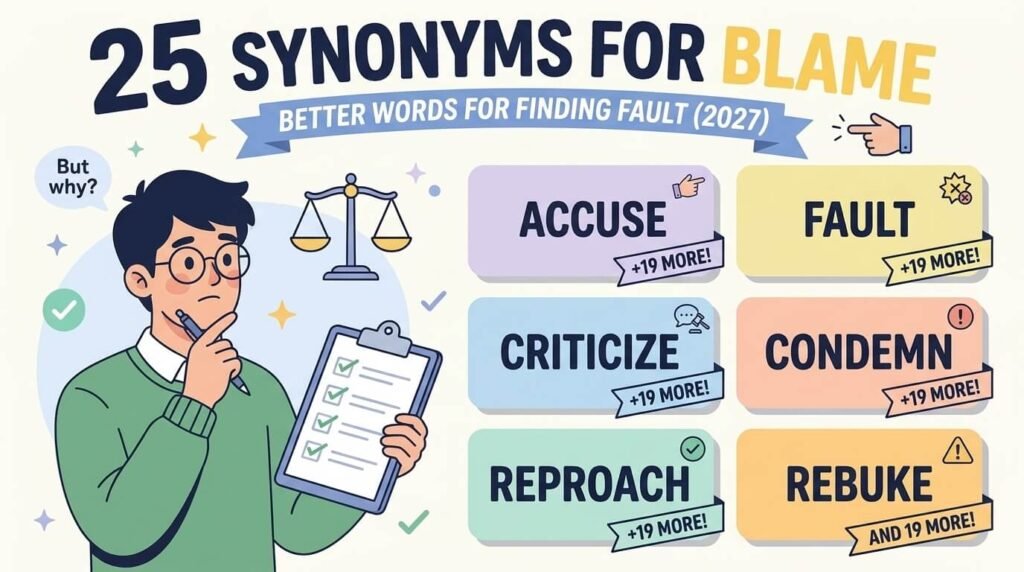

Accuse, fault, criticize, condemn, reproach, censure, rebuke, hold responsible, find at fault, and hold accountable are useful alternatives to the word blame.
Blame is a common word in daily English. We use it when something goes wrong and we think someone caused it. But using the same word again and again can make our writing sound dull. Learning synonyms for blame helps us express our thoughts in a clear and natural way.
For example, if a student makes a mistake, a teacher may blame the student. The teacher may also say that the student is responsible for the mistake.
In simple words, blame means to say that someone did something wrong or caused a problem. Learning other words for blame helps students, bloggers, content writers, and daily English users write better, speak clearly, and share their thoughts with care.
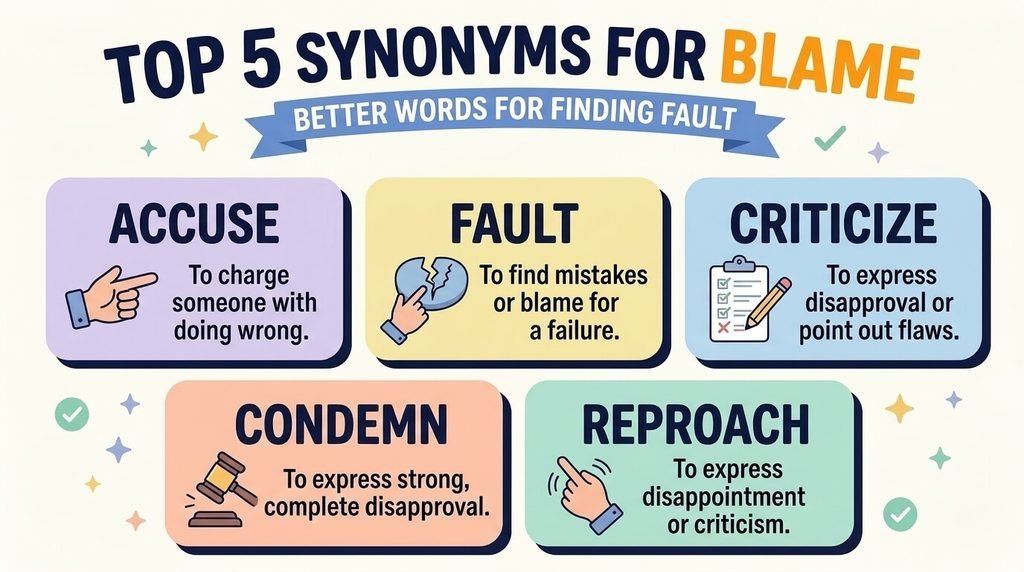
Top 5 Synonyms for Blame – Common and Easy Words
Accuse • Fault • Criticize • Condemn • Hold Responsible
Next 5 Synonyms for Blame – Strong and Formal Words
Censure • Reproach • Rebuke • Denounce • Castigate
More Synonyms for Blame – Words for Everyday English
Reprimand • Reprove • Chide • Admonish • Chastise
Synonyms for Blame – Words for Serious Situations
Upbraid • Berate • Lambaste • Find Fault With • Charge
Synonyms for Blame – Words for Assigning Responsibility
Attribute To • Ascribe To • Impute To • Lay the Blame On • Pin the Blame On
Synonyms for Blame – Words for Accountability
Point the Finger At • Hold Accountable • Assign Responsibility To • Put Down To • Implicate
Synonyms for Blame – Words for Accusations
Incriminate • Indict • Arraign • Tax With • Call Out
Synonyms for Blame – Words for Expressing Disapproval
Take to Task • Scold • Tell Off • Reprimand • Reproof
Synonyms for Blame – Nouns for Responsibility and Fault
Fault • Responsibility • Accountability • Culpability • Guilt
Synonyms for Blame – Nouns for Criticism and Accusation
Liability • Accusation • Charge • Criticism • Censure
Blame Synonyms – Nouns for Strong Disapproval
Condemnation • Reproach • Rebuke • Castigation • Denunciation
Final Synonyms for Blame – Other Useful Nouns
Recrimination • Finger-Pointing • Onus • Reprimand • Reproof
Note: These 50 alternatives cover both meanings of blame: assigning responsibility for a mistake and expressing criticism or disapproval. Some are close synonyms, while others work only in specific situations. The examples below explain their differences.
Pronunciation of Blame
- Phonetic spelling: blaym
- IPA: /bleɪm/
- Simple breakdown: BLAYM
The word blame has one clear sound. It rhymes with words like name, same, and game.
Syllables of Blame
Blame = Blame
- Syllable breakdown:
Blame - Number of syllables: 1
A syllable is one beat in a word. You say blame in one smooth sound.
When to Use Blame and Its Synonyms
Different synonyms for blame work in different situations. The right word depends on what you want to say and how strong your message should be.
| Situation | Best word | Example |
| Saying someone caused a problem | Accuse | They accused him of cheating. |
| Finding someone responsible | Hold responsible | We hold the driver responsible. |
| Finding mistakes | Find fault with | She finds fault with my work. |
| Giving formal criticism | Censure | The board censured the officer. |
| Showing strong disapproval | Condemn | They condemned the unfair act. |
| Correcting someone’s behavior | Reprimand | The manager reprimanded him. |
| Speaking about responsibility | Accountability | Everyone needs accountability. |
| Expressing guilt | Culpability | The report examined his culpability. |
| Placing responsibility somewhere | Attribute to | They attributed the delay to rain. |
| Criticizing someone’s actions | Reproach | She reproached him for lying. |
Quick Tips for Choosing the Right Word
- Use accuse when you say someone did something wrong.
- Use fault when you identify who caused a mistake.
- Use criticize when you point out someone’s mistakes.
- Use condemn when you strongly disapprove of an action.
- Use reprimand when someone in authority formally corrects a person.
- Use accountability when talking about accepting responsibility.
Comparison Table: Top 10 Synonyms for Blame
Here is a quick comparison of common words and their meanings. These alternatives can help you choose better words for essays, emails, blogs, and everyday conversations.
| Word | Simple meaning | Common usage |
| Accuse | Say someone did wrong | Serious claims |
| Fault | Find someone responsible | Mistakes |
| Criticize | Point out problems | Work and behavior |
| Condemn | Strongly disapprove | Serious actions |
| Reproach | Express disappointment | Personal situations |
| Censure | Officially criticize | Formal settings |
| Rebuke | Speak sharply to someone | Wrong behavior |
| Charge | Formally accuse | Legal matters |
| Castigate | Criticize very strongly | Serious mistakes |
| Hold responsible | Say someone caused something | Accountability |
List of 50 Synonyms for Blame
Below are 50 useful words and phrases related to blame. Each one includes a simple meaning and two examples to help you understand its use.
1. Accuse
Meaning
To say that someone did something wrong.
Examples
- They accused him of stealing the money.
- She accused her friend of telling a lie.
2. Fault
Meaning
To say that someone is responsible for a mistake.
Examples
- Do not fault her for one small error.
- The coach faulted the player for arriving late.
3. Criticize
Meaning
To say what someone did wrong or badly.
Examples
- My teacher criticized my messy work.
- He criticized the plan during the meeting.
4. Condemn
Meaning
To say strongly that something is wrong.
Examples
- The school condemned the act of bullying.
- People condemned the unfair decision.
5. Hold Responsible
Meaning
To say that someone must answer for a problem.
Examples
- We hold the company responsible for the damage.
- The parents held him responsible for the mess.
6. Censure
Meaning
To formally show that you strongly disapprove of something.
Examples
- The board censured the official.
- The group censured his rude comments.
7. Reproach
Meaning
To show someone that you are unhappy with their actions.
Examples
- She reproached him for breaking his promise.
- His mother reproached him for being careless.
8. Rebuke
Meaning
To speak sharply to someone about a mistake.
Examples
- The teacher rebuked the noisy students.
- Her boss rebuked her for missing the deadline.
9. Denounce
Meaning
To publicly say that someone or something is wrong.
Examples
- The leader denounced the violent act.
- The group denounced the unfair rule.
10. Castigate
Meaning
To criticize someone very strongly.
Examples
- The coach castigated the team after the loss.
- Critics castigated the company for its poor service.
11. Reprimand
Meaning
To officially tell someone that their behavior was wrong.
Examples
- The manager reprimanded the worker.
- The principal reprimanded the student for cheating.
12. Reprove
Meaning
To tell someone that they have done something wrong.
Examples
- Her father reproved her for speaking rudely.
- The teacher reproved the child for pushing others.
13. Chide
Meaning
To speak to someone about a small mistake.
Examples
- Mom chided me for leaving the door open.
- He chided his son for wasting food.
14. Admonish
Meaning
To warn someone not to do something wrong again.
Examples
- The teacher admonished us to follow the rules.
- Her mother admonished her for crossing the road alone.
15. Chastise
Meaning
To criticize or punish someone for doing wrong.
Examples
- The coach chastised the player for breaking the rules.
- She chastised her brother for his rude behavior.
16. Upbraid
Meaning
To speak angrily to someone about a mistake.
Examples
- His father upbraided him for wasting money.
- The manager upbraided the team for its poor work.
17. Berate
Meaning
To speak angrily to someone for doing something wrong.
Examples
- The customer berated the worker over the delay.
- She berated herself for forgetting the keys.
18. Lambaste
Meaning
To criticize someone or something very harshly.
Examples
- The newspaper lambasted the new policy.
- Fans lambasted the team after its defeat.
19. Find Fault With
Meaning
To notice and complain about someone’s mistakes.
Examples
- My brother finds fault with every meal.
- The editor found fault with the first draft.
20. Charge
Meaning
To officially say that someone has done something wrong.
Examples
- Police charged him with theft.
- The court charged the man with fraud.
21. Attribute To
Meaning
To say that something happened because of someone or something.
Examples
- They attributed the delay to bad weather.
- She attributed her success to hard work.
22. Ascribe To
Meaning
To say that something is caused by a person or thing.
Examples
- He ascribed his failure to poor planning.
- They ascribed the change to new rules.
23. Impute To
Meaning
To say that someone is responsible for an action or fault.
Examples
- The report imputed the error to poor management.
- She imputed bad motives to his actions.
24. Lay the Blame On
Meaning
To say that another person caused a problem.
Examples
- Do not lay the blame on your sister.
- He laid the blame on the wrong worker.
25. Pin the Blame On
Meaning
To try to make someone else seem responsible for a mistake.
Examples
- They tried to pin the blame on the new employee.
- He pinned the blame on his younger brother.
26. Point the Finger At
Meaning
To say that a person is responsible for something bad.
Examples
- Everyone pointed the finger at the driver.
- She refused to point the finger at her friend.
27. Hold Accountable
Meaning
To expect someone to answer for their actions.
Examples
- The school holds students accountable for their actions.
- We must hold leaders accountable for their choices.
28. Assign Responsibility To
Meaning
To give someone responsibility for a task or problem.
Examples
- The report assigned responsibility to the project manager.
- They assigned responsibility to the wrong team.
29. Put Down To
Meaning
To say that something happened because of a certain reason.
Examples
- I put my tiredness down to lack of sleep.
- She put the mistake down to stress.
30. Implicate
Meaning
To show that someone may be involved in a wrong act.
Examples
- The evidence implicated two workers.
- His message implicated him in the plan.
31. Incriminate
Meaning
To make someone appear guilty of a crime or wrong act.
Examples
- The video could incriminate the thief.
- His own words incriminated him.
32. Indict
Meaning
To formally accuse someone of a serious crime.
Examples
- The jury indicted the businessman.
- Prosecutors indicted the man for fraud.
33. Arraign
Meaning
To bring someone before a court to face a criminal charge.
Examples
- The court arraigned the suspect on Monday.
- Officials arraigned the man for theft.
34. Tax With
Meaning
To formally accuse someone of doing something wrong.
Examples
- The writer was taxed with making false claims.
- The officer was taxed with neglecting his duties.
35. Call Out
Meaning
To openly point out someone’s wrong behavior.
Examples
- She called out the bully in front of the class.
- The fans called out the team for poor performance.
36. Take to Task
Meaning
To tell someone firmly that their actions were wrong.
Examples
- The teacher took him to task for cheating.
- My mother took me to task for wasting time.
37. Scold
Meaning
To speak angrily to someone about bad behavior.
Examples
- Dad scolded me for coming home late.
- The teacher scolded the boys for making noise.
38. Tell Off
Meaning
To speak angrily to someone because they did something wrong.
Examples
- She told off her brother for breaking the toy.
- The boss told him off for missing work.
39. Fault (Noun)
Meaning
A mistake or wrong action that someone is responsible for.
Examples
- The accident was not my fault.
- It was his fault that the glass broke.
40. Responsibility
Meaning
The duty to answer for something you do.
Examples
- She accepted responsibility for the mistake.
- We share responsibility for the project.
41. Accountability
Meaning
The duty to explain and answer for your actions.
Examples
- Good leaders accept accountability.
- The school promotes accountability among students.
42. Culpability
Meaning
The state of being responsible for something wrong.
Examples
- The investigation examined his culpability.
- The report questioned the manager’s culpability.
43. Guilt
Meaning
The fact or feeling of being responsible for a wrong act.
Examples
- The evidence proved his guilt.
- She felt guilt after hurting her friend.
44. Liability
Meaning
Legal or financial responsibility for a mistake or loss.
Examples
- The company accepted liability for the damage.
- The contract explains who has liability.
45. Accusation
Meaning
A statement that someone has done something wrong.
Examples
- He denied the accusation.
- The accusation caused a family argument.
46. Criticism
Meaning
Words that point out mistakes or problems.
Examples
- She accepted the criticism with a smile.
- His work received criticism from the editor.
47. Condemnation
Meaning
A strong statement that something is wrong.
Examples
- The decision faced public condemnation.
- The group issued a condemnation of the attack.
48. Rebuke (Noun)
Meaning
A sharp statement that tells someone they did something wrong.
Examples
- The student received a rebuke from the teacher.
- His rude words earned him a public rebuke.
49. Recrimination
Meaning
A statement that blames another person, often during an argument.
Examples
- The meeting turned into a series of recriminations.
- Their argument was full of recriminations.
50. Onus
Meaning
The responsibility or duty to do something or prove something.
Examples
- The onus is on you to finish the work.
- The onus is on the company to explain the delay.
How to Choose Between Blame, Accuse, Fault, and Criticize
These words may look alike, but they do not always mean the same thing.
- Blame: Say who caused a problem.
- Accuse: Say someone did something wrong, sometimes without proof.
- Fault: Find someone responsible for a mistake.
- Criticize: Point out what someone did badly.
- Condemn: Show strong disapproval of an action.
- Reproach: Express disappointment in someone’s behavior.
- Rebuke: Speak sharply to someone about a mistake.
For example, you can criticize someone’s work without blaming them for a problem. This small difference makes your English more accurate.
True Synonyms vs. Related Words for Blame
Not every alternative to blame has exactly the same meaning.
| Word | Relationship to blame |
| Accuse | Very close verb synonym |
| Fault | Direct verb and noun synonym |
| Censure | Formal expression of blame |
| Reproach | Expressing blame or disappointment |
| Responsibility | Noun related to being at fault |
| Culpability | Being responsible for wrongdoing |
| Indict | A specific legal accusation |
| Admonish | Warn or correct someone |
| Liability | Legal or financial responsibility |
| Recrimination | Blaming someone in return |
Important: Words such as indict, arraign, admonish, and liability are not interchangeable with blame in every sentence. Choose them according to their exact meaning.
Antonyms of Blame
Learning opposite words is also useful. These words help you express forgiveness, support, and approval.
| Antonym | Simple meaning |
| Forgive | Stop being angry about a mistake |
| Excuse | Accept a reason for an action |
| Absolve | Free someone from blame |
| Exonerate | Show that someone is not guilty |
| Acquit | Find someone not guilty in court |
| Vindicate | Prove that someone was right |
| Praise | Say something good about someone |
| Commend | Express approval |
| Exculpate | Show that someone is not responsible |
Using these words can make your writing more balanced and positive.
Why Learning Synonyms for Blame Improves Your English
Learning new vocabulary is not just about knowing more words. It is about knowing when and how to use them.
Here are five ways these words can improve your English.
- Better writing: Use different words in essays, articles, and blog posts.
- Clear communication: Explain mistakes and responsibility more accurately.
- Better speaking: Choose the right words during discussions.
- Stronger vocabulary: Understand formal, informal, and professional English.
- More thoughtful conversations: Express disagreement without always sounding harsh.
Remember, words have power. You can correct someone without hurting their feelings. You can accept your mistakes without losing confidence. You can also choose forgiveness instead of blame.
Frequently Asked Questions About Synonyms for Blame
1. What is another word for blame?
Some common alternatives are accuse, fault, criticize, condemn, reproach, and censure. The best choice depends on the sentence.
2. What are the 5 best synonyms for blame?
The five useful alternatives are:
- Accuse
- Fault
- Criticize
- Condemn
- Hold responsible
These words work in many everyday and formal situations.
3. What is a stronger word for blame?
Castigate, censure, denounce, and condemn can express stronger criticism or disapproval. Castigate is especially strong.
4. What is a polite word for blame?
Hold responsible and identify responsibility can sound more neutral. You can also use address the mistake when you want to focus on solving a problem instead of attacking someone.
5. What is the difference between blame and accuse?
Blame means saying someone is responsible for a problem. Accuse means saying someone has done something wrong.
For example:
- I blame him for the delay.
- I accuse him of stealing.
6. What is the opposite of blame?
Common opposites include forgive, excuse, absolve, exonerate, acquit, and vindicate. These words express freedom from blame or a lack of guilt.
7. What is the noun form of blame?
Blame is already a noun as well as a verb. Other related nouns include accusation, fault, responsibility, culpability, guilt, and criticism.
8. How can I use blame in a sentence?
You can use blame when you want to say that someone caused a problem.
Examples:
- Do not blame others for your mistakes.
- She blamed the rain for the delay.
- The manager accepted the blame for the error.
9. What are formal alternatives to blame?
Formal alternatives include censure, reproach, condemn, impute, attribute responsibility, and hold accountable. These words are useful in professional reports, academic writing, and formal discussions.
10. How can I improve my vocabulary with synonyms for blame?
Start by learning five words at a time. Understand their meanings and write two sentences with each word.
Try using them in emails, essays, social media captions, and daily conversations. Regular practice will help you remember them.
Conclusion
Learning synonyms for blame can make your English stronger and your communication clearer. Words like accuse, criticize, censure, and reproach help you explain mistakes in different ways.
Knowing another word for blame also helps you write better essays, blog posts, emails, and social media captions. These blame synonyms give you more choices when speaking or writing.
Remember, synonyms for blame are not all the same. Some express mild criticism, while others show strong disapproval. Learning their differences will improve your vocabulary and help you choose the right words.
Practice these blame alternatives in daily conversations. Read new words, write simple sentences, and use them with confidence.
Every new word you learn brings you one step closer to better English. Keep learning, keep growing, and let your words make a positive difference!
READ MORE: 50 Synonyms for Nonsense: Better Words for Foolish Talk (2027)